Orvynelqis
Slate Pattern
Slate Pattern
Couldn't load pickup availability
1. Problem Statement
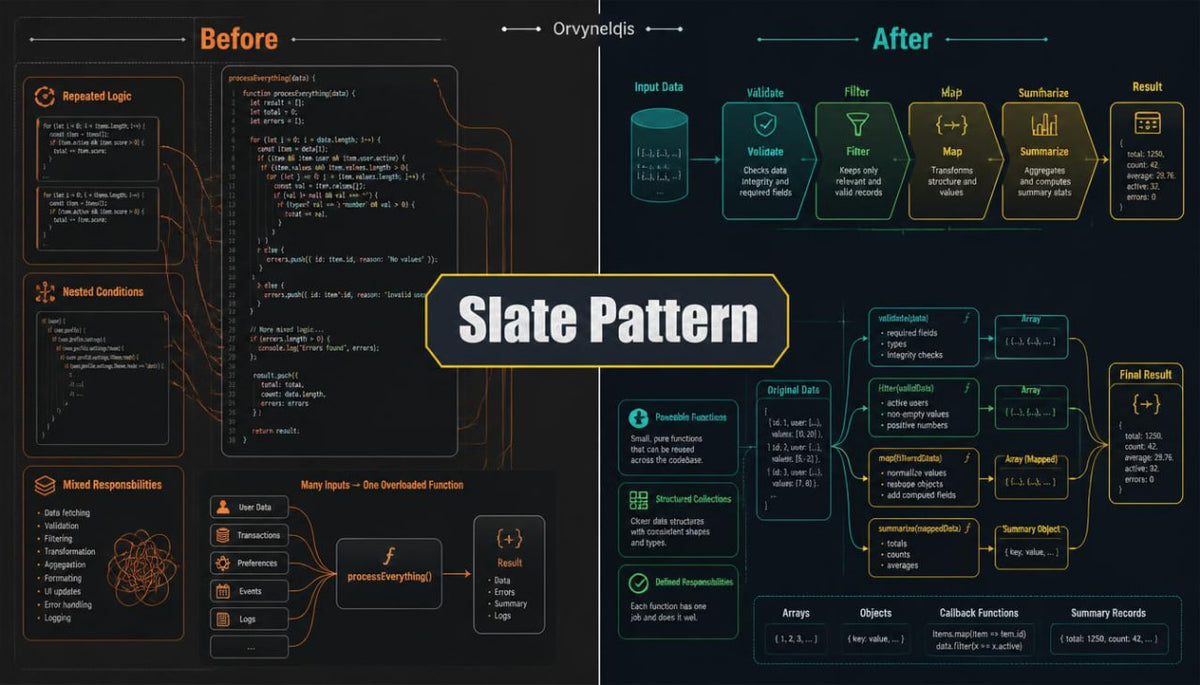
As JavaScript programs grow beyond introductory exercises, organizing information and maintaining clear relationships between different operations becomes increasingly important. Learners may understand individual functions, arrays, and objects but encounter difficulties when these elements need to interact within a larger programming task. Repeated instructions, deeply nested conditions, and scattered data can make code harder to read, modify, and examine. Without a clear approach to organizing programming logic, even relatively small projects can become difficult to follow as additional requirements are introduced. Learning to recognize recurring structures and arrange code into meaningful sections provides a valuable foundation for working with more detailed JavaScript applications.
2. Solution
Slate Pattern introduces a structured approach to organizing JavaScript logic through practical examples and carefully arranged learning modules. The course examines how functions, arrays, objects, and common language features can be combined to create readable and reusable programming structures. Learners explore methods for processing collections, organizing related information, and separating programming responsibilities into individual sections. Guided activities demonstrate how different coding approaches can produce similar results while offering different ways to arrange and maintain the underlying logic. Through detailed explanations and applied exercises, the materials support a deeper understanding of JavaScript structure, data handling, and program organization.
3. What's Inside
Module 1 — Recognizing Patterns in JavaScript
The opening module introduces the concept of recurring programming structures and explains why recognizing them can help organize code.
Learners examine examples containing repeated expressions, similar conditional statements, and functions that perform related operations.
The materials demonstrate how these structures can be identified, compared, and reorganized into clearer arrangements.
Topics include code repetition, responsibility separation, naming conventions, and the relationship between individual functions and larger operations.
A guided exercise presents a collection of related instructions and asks learners to identify opportunities for restructuring them into smaller functional units.
The module concludes with a comparison of different organizational approaches, encouraging readers to consider how code arrangement influences readability.
Module 2 — Functions as Building Blocks
This module explores functions as reusable components of JavaScript programs.
Learners revisit function declarations, expressions, and arrow functions before examining more detailed applications of parameters and return values.
The course introduces default parameters, rest parameters, and the distinction between functions that calculate results and functions that modify existing information.
Particular attention is given to understanding how information moves into and out of functions.
Examples demonstrate how several functions can work together to complete a larger operation.
A practical activity involves creating a collection of functions that examine numerical records, apply conditions, and generate structured summaries.
Readers also explore how meaningful function names and clearly defined responsibilities contribute to readable code.
Module 3 — Arrays Beyond Basic Iteration
Arrays provide a flexible structure for organizing collections of related information.
This module introduces array processing methods that support different approaches to examining and arranging stored values.
Learners explore map(), filter(), find(), some(), and every(), studying how each method behaves and what type of result it produces.
The course explains the relationship between callback functions and array methods through examples involving numeric values, text entries, and structured records.
Practical exercises include selecting entries that meet defined conditions, creating modified collections, and examining whether particular values appear within a dataset.
The material also discusses the difference between methods that create new arrays and operations that change an existing collection.
Module 4 — Organizing Information With Objects
Objects allow related values to be represented within a single structured record.
This module examines object properties, nested objects, and arrays containing multiple records.
Learners explore how to retrieve information from nested structures and how to update individual properties without changing unrelated entries.
The materials introduce object destructuring and explain how selected properties can be assigned to local variables.
Examples demonstrate how structured records might represent educational activities, catalog entries, and grouped observations.
A guided exercise involves preparing a small collection of records, retrieving selected fields, and creating summary information from the stored values.
The module also introduces the spread syntax in the context of copying and combining object properties.
Module 5 — Scope, Closures, and Function Relationships
Understanding where variables are declared and how functions reference them is an important part of organizing JavaScript programs.
This module examines global scope, function scope, and block scope through practical examples.
Learners explore how variable declarations influence the sections of code in which values can be referenced.
The course introduces lexical scope and explains how inner functions can refer to variables declared in surrounding functions.
Closures are presented through small examples that maintain information between function calls.
A practical activity involves constructing a counter function and examining how its internal value changes when the returned function is called repeatedly.
The module also discusses why unnecessary shared state can make program behavior harder to understand.
Module 6 — Turning Collections Into Summaries
This section focuses on processing collections and producing meaningful information from individual entries.
Learners examine the reduce() method and explore how an accumulator can collect results across an array.
Examples introduce numeric totals, category counts, grouped records, and introductory summary calculations.
The materials compare traditional loops with array methods, showing how different structures represent similar operations.
Readers investigate how initial accumulator values influence the result and how different callback expressions affect the calculation.
A guided exercise involves processing a collection of structured records and generating a summary containing totals, categories, and selected values.
The module concludes with an examination of how collection-processing operations can be divided into smaller, independently readable functions.
Module 7 — Data Validation and Clearer Decisions
Programs frequently receive information that requires examination before it can be used in further calculations.
This module introduces elementary validation techniques for strings, numeric values, arrays, and objects.
Learners explore how conditional logic can identify missing values, unexpected types, and entries that do not follow defined formatting rules.
The course demonstrates how validation functions can return Boolean values or structured descriptions of identified issues.
Examples include examining text fields, checking numeric ranges, and confirming that an object contains required properties.
A practical activity involves creating a validation sequence for a small collection of records.
The material also introduces early return statements and examines how they can reduce deeply nested conditions.
Module 8 — Bringing the Patterns Together
The concluding module combines the concepts introduced throughout Slate Pattern into a connected programming activity.
Learners work with a fictional learning activity catalog containing records with titles, categories, durations, and completion states.
The exercise involves organizing the records into arrays and objects, validating individual entries, and creating functions that retrieve selected information.
Readers then apply array methods to filter activities, generate summary calculations, and prepare categorized results.
Additional tasks invite learners to reorganize repeated logic, experiment with different function arrangements, and document the purpose of individual operations.
The final review examines how data structures, function relationships, and collection-processing methods contribute to the organization of a complete programming workflow.
4. Who Is This For?
Slate Pattern is intended for learners who already understand introductory JavaScript syntax and want to explore more detailed approaches to organizing programming logic.
The course is suitable for individuals familiar with variables, conditions, loops, functions, arrays, and basic object structures.
It may be particularly relevant for learners who can write short JavaScript exercises but would like to understand how individual operations connect within larger programming activities.
Readers interested in data processing, reusable functions, and structured problem-solving will encounter practical examples related to these areas.
The materials focus on strengthening knowledge of language features and organizing code rather than introducing specialized development environments or complex application infrastructure.
5. What You'll Learn
Slate Pattern explores the following programming skills and knowledge areas:
-
Recognize repeated structures within JavaScript code.
-
Organize related instructions into reusable functions.
-
Apply default parameters and rest parameters.
-
Distinguish between calculations that return values and operations that modify data.
-
Process arrays using
map(),filter(), andfind(). -
Examine collections with
some()andevery(). -
Explain how callback functions interact with array methods.
-
Organize related information using nested objects.
-
Retrieve and modify properties within structured records.
-
Apply destructuring to extract selected values.
-
Use spread syntax when combining or copying data structures.
-
Describe lexical scope and introductory closure behavior.
-
Process collections using
reduce(). -
Generate numeric summaries and grouped results.
-
Create validation functions for structured information.
-
Identify opportunities to simplify nested conditional logic.
-
Separate programming responsibilities into smaller functional units.
-
Combine functions, arrays, and objects within a connected JavaScript exercise.
6. 30-Day Refund Terms
Slate Pattern is a paid educational course containing structured JavaScript learning materials, written explanations, coding examples, and practical exercises.
A refund may be requested within 30 days of the purchase date, subject to the conditions described in the published Orvynelqis Refund Policy.
Learners are encouraged to review the course description and included topics before purchasing the materials.
Refund requests can be submitted through the contact information provided on the Orvynelqis website and will be reviewed according to the published policy.
The course is designed for independent educational study, allowing readers to examine explanations, revisit programming examples, and complete practical activities according to their individual study schedules.
Learning outcomes depend on previous knowledge, participation in exercises, and the time devoted to reviewing the materials.
How are Orvynelqis courses organized?
How are Orvynelqis courses organized?
Our JavaScript courses follow a structured learning approach, with topics arranged into sections that connect related concepts. Each course focuses on specific areas of JavaScript, combining explanations, practical examples, and exercises. The depth of the material varies depending on the selected course.
Do I need previous programming knowledge?
Do I need previous programming knowledge?
Required background knowledge depends on the course you choose. Introductory materials explain fundamental programming concepts, while later courses examine more detailed techniques and development practices. Review each course description to understand its topics and recommended starting knowledge.
What will I find in the learning materials?
What will I find in the learning materials?
Course materials cover JavaScript concepts through written explanations, code examples, practical tasks, and topic reviews. The exact subjects and activities depend on the course. Each description outlines its learning focus so you can choose materials that match your interests.
- 📥 Digital file available after purchase
- 📚 Long-term availability
- 🔒 Secure checkout
- 📅 Content updated in 2026
Self-paced learning overview
Share