Orvynelqis
Lattice Blueprint
Lattice Blueprint
Couldn't load pickup availability
1. Problem Statement
As JavaScript programs develop additional features and increasingly detailed operations, maintaining a clear structure becomes an important part of the development process. Learners may understand how to write functions and work with structured information but encounter difficulties when multiple sections of code depend on one another. Closely connected functions, repeated operations, and unclear responsibilities can make it difficult to introduce changes without affecting unrelated behavior. Programs built without an organized structure may become harder to examine as new requirements and data relationships appear. Understanding how to divide programming responsibilities and establish clear connections between components provides a foundation for developing more organized JavaScript projects.
2. Solution
Lattice Blueprint introduces practical approaches to JavaScript program organization through structured lessons focused on modular thinking and connected programming components. The course examines how individual functions, objects, and modules can perform clearly defined responsibilities while contributing to a larger workflow. Learners explore techniques for organizing dependencies, defining communication between components, and separating data processing from other programming operations. Guided exercises demonstrate how different structural arrangements influence readability, maintainability, and the behavior of connected code. Through a detailed practical project, the materials bring together modular design, reusable logic, data organization, and structured code review.
3. What's Inside
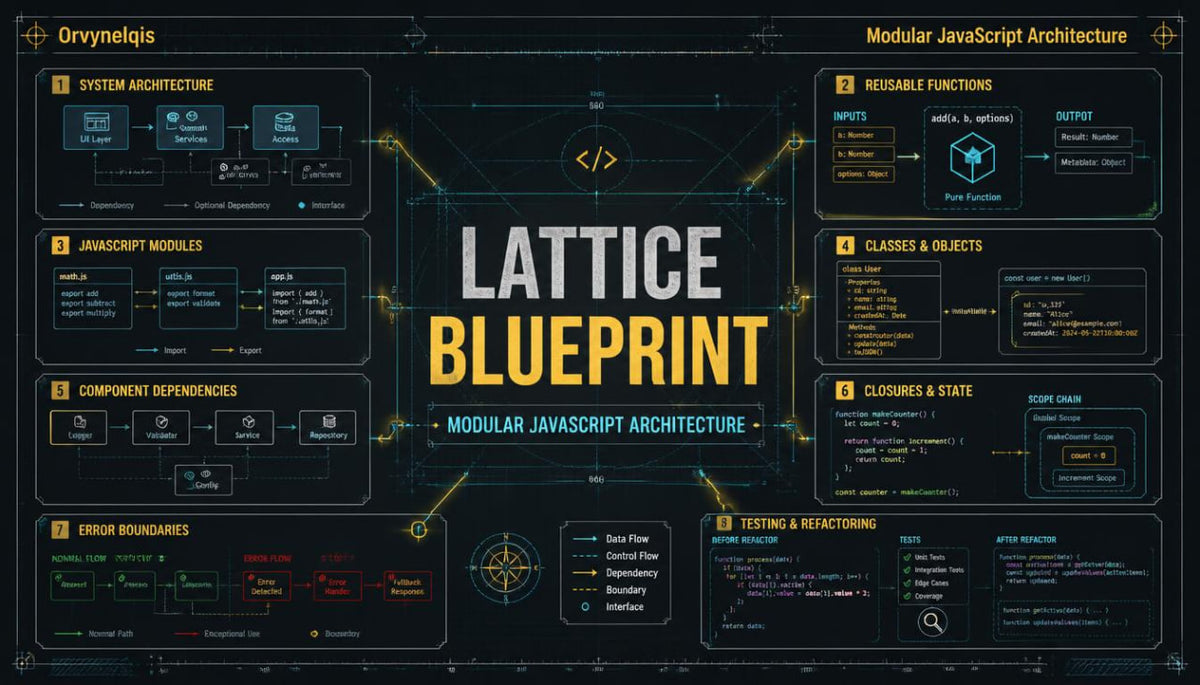
Module 1 — Understanding Program Architecture
The opening module introduces the relationship between individual instructions and the broader structure of a JavaScript program.
Learners examine how code organization changes as a project moves from several independent functions to multiple connected components.
The materials introduce separation of concerns, functional responsibilities, and the idea of dividing a larger programming task into smaller units.
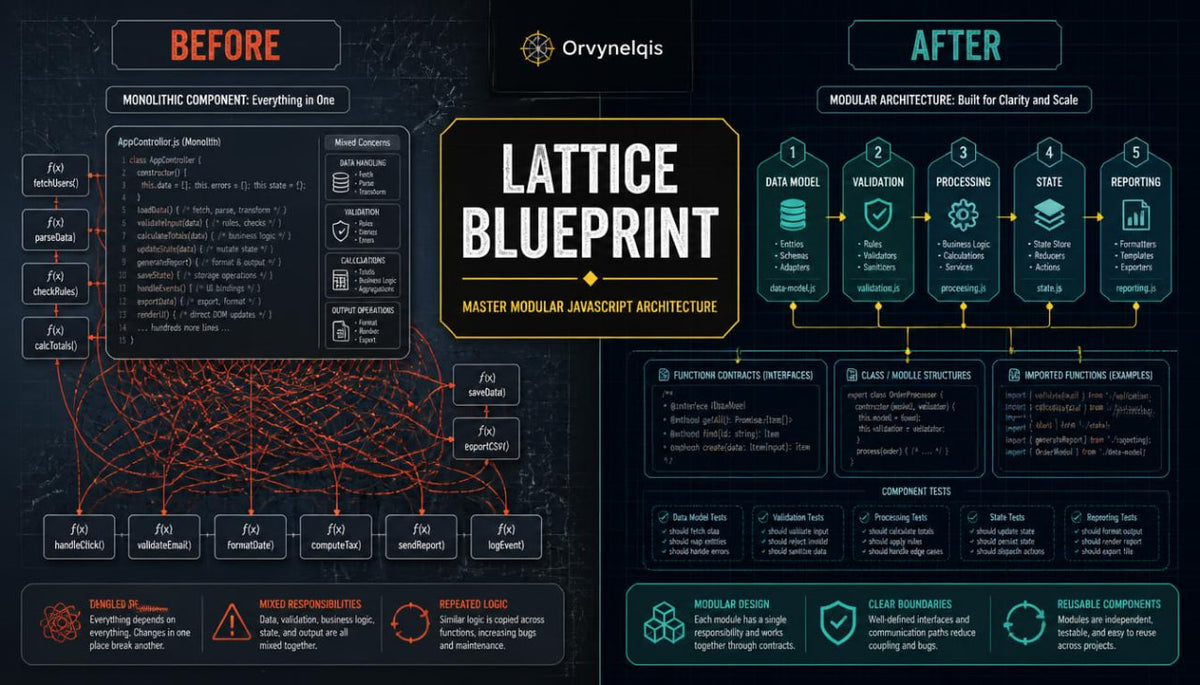
Examples compare a single collection of interconnected instructions with an arrangement of functions grouped according to their purpose.
The practical activity involves examining a fictional record-management program and identifying which operations belong together.
Readers then prepare a simple structural outline showing the relationships between data preparation, validation, processing, and output formatting.
Module 2 — Designing Reusable Functions
Functions play a central role in building programming structures that can be understood and modified independently.
This module examines function design beyond basic declarations and return statements.
Learners explore how to define clear inputs, organize internal operations, and return results that can be used by other functions.
Topics include function contracts, predictable outputs, single-responsibility principles, and the difference between calculation functions and procedures that change external state.
Examples demonstrate how several related operations can be separated into smaller functions without unnecessarily repeating code.
A guided activity involves reorganizing a lengthy data-processing function into a collection of individual operations.
The closing discussion examines how descriptive naming and consistent parameters contribute to readable JavaScript code.
Module 3 — Modular Design and Code Boundaries
A module groups related programming behavior into a defined section of a larger program.
This module introduces JavaScript module concepts through exports, imports, and the arrangement of related functions.
Learners explore named exports, default exports, and how imported functionality can be used within another module.
The course explains why module boundaries matter when different parts of a program depend on shared operations.
Examples demonstrate the separation of record creation, validation, data processing, and result formatting into distinct modules.
A practical exercise asks learners to design a small module structure for a collection-processing project.
The materials also discuss circular dependencies and why understanding relationships between modules matters when planning program structure.
Module 4 — Objects, Constructors, and Classes
JavaScript objects can represent information while also grouping operations associated with that information.
This module explores object methods, constructor functions, and introductory class syntax.
Learners examine how instances can be created from shared definitions and how individual objects can maintain their own data.
The course introduces constructors, instance methods, and the role of this within different programming contexts.
Examples demonstrate how a collection of related records can be represented through class instances.
The materials also examine how object-based organization differs from arranging the same operations into independent functions.
A practical activity involves designing a simple class that represents a learning record and provides methods for examining and updating selected properties.
Module 5 — Managing Dependencies Between Components
Connected programming components frequently depend on information or operations provided by other sections of a program.
This module examines how dependencies develop and how their arrangement influences program structure.
Learners explore direct function calls, parameter-based communication, and the practice of passing required functionality into another function.
The materials introduce dependency injection as a general design concept using small JavaScript examples.
Readers examine the difference between a function that directly relies on shared state and one that receives the information it needs through parameters.
Practical examples involve record repositories, filtering operations, and formatting functions.
The guided activity asks learners to reorganize several connected functions so that their required inputs and responsibilities are clearly identifiable.
Module 6 — Closures and Controlled State
Managing values shared across different operations requires careful consideration of scope and state.
This module develops the concepts of lexical scope and closures through practical programming structures.
Learners examine how an inner function can retain a relationship with values declared in its surrounding scope.
Examples introduce counters, stateful record collections, and small factory functions that create independent instances of related behavior.
The materials compare closure-based arrangements with object-based approaches to maintaining information.
A guided exercise involves constructing a record manager that provides selected operations while keeping its internal collection separate from unrelated code.
Readers also examine how uncontrolled changes to shared data can influence several connected operations.
Module 7 — Organizing Errors Across Components
Errors become harder to examine when information passes through multiple functions and modules.
This module explores how JavaScript operations can describe unexpected conditions and communicate them to related components.
Learners revisit try, catch, and throw while examining the difference between validation failures and execution exceptions.
The course introduces custom error classes and demonstrates how descriptive error information can identify the origin of a problem.
Examples show how validation functions, record-processing operations, and coordinating functions can handle different categories of issues.
A practical activity involves defining error responses for invalid records and examining how those responses move through a connected programming workflow.
The module emphasizes meaningful error descriptions and careful separation between ordinary program results and exceptional conditions.
Module 8 — Reviewing, Testing, and Refining Structure
Organized code should also be examined to understand whether its behavior matches the intended requirements.
This module introduces function-level testing through sample inputs, expected outputs, and comparisons with actual results.
Learners explore boundary values, empty collections, invalid information, and repeated operations.
The materials explain how small, clearly defined functions can be examined independently before they are connected to other components.
Examples demonstrate how to write simple assertions and organize test cases for record-processing functions.
The course also introduces refactoring as the practice of revising code structure without intentionally changing its observable behavior.
A guided activity involves reviewing a collection of functions, identifying repeated logic, and documenting the changes made during restructuring.
Module 9 — Applied Project: The Modular Learning Archive
The concluding module brings the course concepts together through the construction of a modular JavaScript learning archive.
The project begins with a collection of fictional educational records containing identifiers, titles, categories, descriptions, and completion information.
Learners define the structure of these records and create functions for examining incoming information.
The next stage introduces separate modules responsible for record construction, validation, searching, and summary generation.
Readers explore how these modules communicate and how individual responsibilities contribute to the complete workflow.
Additional exercises introduce object-oriented structures for representing records and closure-based functions for maintaining selected application state.
The project includes error-handling scenarios involving invalid entries, missing identifiers, and unsupported operations.
The final stage focuses on testing individual functions, examining module relationships, and reorganizing repeated code.
Learners complete the activity by preparing a short architectural outline describing the responsibilities and connections of the individual components.
4. Who Is This For?
Lattice Blueprint is intended for learners who already understand JavaScript fundamentals and want to examine how larger programming structures are designed.
The course is suitable for individuals familiar with functions, arrays, objects, conditional logic, collection-processing methods, and introductory error handling.
It is particularly relevant for learners who have written connected programming exercises and want to explore approaches to dividing code into smaller, independently understandable sections.
Readers interested in modular design, object-oriented programming, functional organization, and reusable programming components will find detailed examples related to these topics.
The course assumes familiarity with fundamental JavaScript syntax and concentrates on organizing existing knowledge into connected programming structures.
5. What You'll Learn
Lattice Blueprint covers the following programming concepts and practical skills:
-
Explain the relationship between individual functions and broader program architecture.
-
Identify separate responsibilities within a JavaScript programming workflow.
-
Design functions with clearly defined inputs and return values.
-
Organize related functions into modules.
-
Apply named and default exports.
-
Examine relationships and dependencies between modules.
-
Create objects with associated methods.
-
Define and instantiate JavaScript classes.
-
Describe the role of constructors and instance properties.
-
Understand the behavior of
thisin common programming contexts. -
Compare object-oriented and function-based structures.
-
Apply parameter-based communication between components.
-
Explore introductory dependency injection techniques.
-
Use closures to maintain internal state.
-
Construct factory functions that create related programming behavior.
-
Distinguish validation failures from execution exceptions.
-
Create descriptive error responses and custom error classes.
-
Prepare test cases for individual functions.
-
Examine boundary conditions and unexpected input values.
-
Refactor repeated programming logic into reusable components.
-
Design a modular JavaScript archive with connected operations.
-
Document the responsibilities and relationships of programming components.
6. 30-Day Refund Terms
Lattice Blueprint is a paid educational course containing structured JavaScript learning materials, technical explanations, worked examples, and applied programming exercises.
Learners may request a refund within 30 days following purchase, subject to the conditions described in the published Orvynelqis Refund Policy.
Refund requests can be submitted through the contact information provided on the Orvynelqis website.
Each request will be reviewed according to the published refund procedures and applicable consumer protection requirements.
Learners are encouraged to examine the course description, included modules, recommended background knowledge, and refund conditions before purchasing.
The course is intended for independent educational study, with written materials and exercises that can be reviewed according to the learner's individual schedule.
Learning progress depends on previous programming knowledge, engagement with the exercises, and the time devoted to studying the material.
How are Orvynelqis courses organized?
How are Orvynelqis courses organized?
Our JavaScript courses follow a structured learning approach, with topics arranged into sections that connect related concepts. Each course focuses on specific areas of JavaScript, combining explanations, practical examples, and exercises. The depth of the material varies depending on the selected course.
Do I need previous programming knowledge?
Do I need previous programming knowledge?
Required background knowledge depends on the course you choose. Introductory materials explain fundamental programming concepts, while later courses examine more detailed techniques and development practices. Review each course description to understand its topics and recommended starting knowledge.
What will I find in the learning materials?
What will I find in the learning materials?
Course materials cover JavaScript concepts through written explanations, code examples, practical tasks, and topic reviews. The exact subjects and activities depend on the course. Each description outlines its learning focus so you can choose materials that match your interests.
- 📥 Digital file available after purchase
- 📚 Long-term availability
- 🔒 Secure checkout
- 📅 Content updated in 2026
Self-paced learning overview
Share