Orvynelqis
Echo Collection
Echo Collection
Couldn't load pickup availability
1. Problem Statement
As JavaScript projects involve increasingly detailed collections of information, managing relationships between records and maintaining consistent processing behavior becomes more challenging. Learners may understand arrays, objects, and individual functions but encounter difficulties when information must pass through several connected operations. Repeated data processing, inconsistent record structures, and unexpected changes to shared information can make programming logic difficult to follow. Understanding how collections interact with functions and how data changes throughout a workflow requires careful examination of intermediate results. Developing structured approaches to organizing these operations helps learners work with detailed JavaScript data-processing tasks.
2. Solution
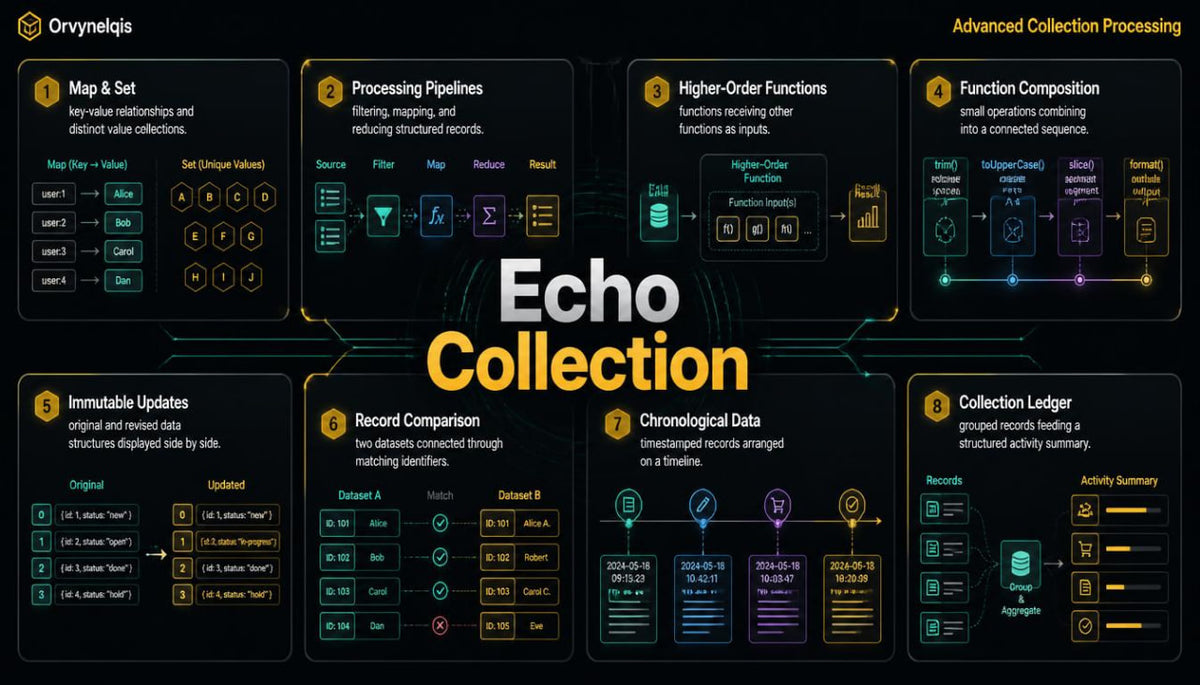
Echo Collection introduces a structured learning approach centered on advanced JavaScript collections and connected data-processing techniques. The course examines how information can be grouped, compared, reorganized, and processed through reusable functions. Learners explore collection methods, functional composition, data relationships, and techniques for reducing unnecessary changes to existing information. Guided programming exercises demonstrate how individual operations contribute to larger workflows while maintaining clearly defined responsibilities. The materials conclude with an applied project combining collection processing, record comparison, validation, and summary generation.
3. What's Inside
Module 1 — Understanding Collection Relationships
The opening module examines how JavaScript collections represent information and how relationships between different records can be organized.
Learners revisit arrays and objects before exploring collections containing nested structures, repeated identifiers, and connected entries.
The materials explain how collection design influences retrieval, comparison, and modification operations.
Examples demonstrate relationships between activity records, categories, descriptive information, and recorded changes.
Readers examine how separate collections can reference related information through shared identifiers.
A guided activity involves designing a collection structure that connects activity descriptions with individual observations.
The module concludes with an examination of how clear record relationships contribute to readable programming workflows.
Module 2 — Working With Map and Set
JavaScript provides collection structures beyond traditional arrays and objects.
This module introduces Map and Set, examining their properties and common applications.
Learners explore how a Map stores key-value relationships and how a Set represents a collection of distinct values.
The course compares these structures with arrays and ordinary objects, highlighting differences in retrieval, iteration, and data representation.
Examples demonstrate storing category information, identifying repeated entries, and organizing records by identifier.
A practical exercise involves processing a collection of observations and constructing a separate group of distinct category labels.
Readers then use a Map to associate identifiers with corresponding record details.
Module 3 — Building Connected Data Operations
Data-processing tasks often involve several operations performed in a particular sequence.
This module examines how JavaScript array methods can be combined into connected processing workflows.
Learners explore how filter(), map(), and reduce() can contribute different operations to a complete calculation.
The materials demonstrate how intermediate values move between individual processing stages.
Examples include selecting valid records, extracting particular properties, calculating grouped totals, and preparing structured summaries.
Readers compare a sequence of collection methods with an equivalent arrangement of loops and functions.
A guided exercise involves processing a set of fictional activity records and documenting the result of each stage.
Module 4 — Function Composition and Reusable Operations
Complex processing workflows become easier to examine when individual operations have clearly defined responsibilities.
This module explores function composition and the relationship between reusable functions.
Learners examine functions that receive values, perform individual operations, and return information for further processing.
The course introduces higher-order functions and explains how functions can be passed as arguments or returned from other functions.
Practical examples demonstrate reusable filtering rules, comparison functions, and formatting operations.
Readers explore how small functions can be combined to create different data-processing sequences without duplicating their internal logic.
The guided activity involves constructing a series of functions that categorize records, calculate summaries, and prepare a structured report.
Module 5 — Managing Changes to Shared Data
Understanding how information changes during program execution is an important part of collection processing.
This section examines mutable and immutable approaches to working with JavaScript arrays and objects.
Learners explore how object references influence assignments and how modifying nested information can affect related values.
The materials introduce shallow copying, spread syntax, and approaches to constructing revised collections.
Examples demonstrate updating individual records, adding entries, and removing selected information while retaining the original collection.
Readers examine the differences between operations that modify existing structures and those that return new ones.
A practical exercise involves maintaining an original collection of activity records while producing several independently modified versions.
Module 6 — Comparing and Reconciling Records
Collections may contain information representing different stages of the same underlying data.
This module introduces techniques for comparing related collections and identifying differences between records.
Learners explore comparison functions, matching identifiers, and strategies for finding missing or modified entries.
The course demonstrates how Map and Set can support record comparison and membership checks.
Examples include comparing two activity lists, identifying newly introduced records, and examining changes to existing information.
A guided exercise involves preparing two fictional data collections and generating a summary of additions, modifications, and removals.
The materials also examine how validation rules can help distinguish legitimate changes from inconsistent information.
Module 7 — Organizing Historical Information
Some programming tasks involve examining not only current information but also records of previous changes.
This module introduces introductory approaches to representing historical information in JavaScript.
Learners examine timestamped records, activity sequences, and collections containing several observations associated with the same identifier.
The materials explain how ordering and grouping influence the interpretation of historical information.
Examples demonstrate creating activity timelines, arranging records chronologically, and calculating summary information across different periods.
Readers explore how JavaScript date values can be used within sorting and comparison operations.
A practical exercise involves producing a chronological report from a collection of fictional activity entries.
The module concludes with a discussion of why clearly defined date formats and consistent record structures matter.
Module 8 — Validation, Testing, and Data Review
Detailed collection workflows require careful examination of incoming information and processing behavior.
This module revisits validation through examples involving nested records, missing identifiers, unexpected value types, and repeated entries.
Learners examine how validation can occur before data enters a processing sequence.
The course introduces testing approaches for functions that filter, group, compare, and summarize collections.
Examples include empty arrays, missing properties, repeated values, and records containing unexpected information.
A guided activity involves preparing several test cases for a collection-processing function and comparing the resulting values with defined expectations.
Readers also explore how documenting assumptions about input structures contributes to clearer code.
Module 9 — Applied Project: The Activity Collection Ledger
The concluding project connects the course topics through the development of a JavaScript activity ledger.
Learners begin with a fictional collection of activity records containing identifiers, categories, descriptive information, dates, and status values.
The project introduces functions responsible for examining incoming records and organizing them into related collections.
Readers use Map and Set to organize identifiers, identify distinct categories, and examine repeated information.
Additional operations filter entries, prepare chronological sequences, and generate grouped summaries.
The next stage introduces record comparison, allowing learners to identify additions and changes between two versions of a collection.
The project also includes activities involving immutable updates and testing individual processing functions.
The closing review asks learners to document the structure of the workflow, describe the purpose of each operation, and examine how information moves between connected sections.
4. Who Is This For?
Echo Collection is intended for learners who already understand foundational JavaScript programming and want to examine more detailed data-processing techniques.
The course is suitable for individuals familiar with functions, arrays, objects, collection methods, modular code organization, and introductory validation.
It may be particularly relevant for learners interested in organizing datasets, comparing related records, and constructing reusable processing operations.
Readers who have completed smaller programming activities and want to work with connected collection workflows will encounter exercises that combine several established JavaScript concepts.
The materials concentrate on structured information processing, functional organization, and practical code examination.
5. What You'll Learn
Echo Collection covers the following programming concepts and practical skills:
-
Design relationships between structured JavaScript records.
-
Organize nested collections using arrays and objects.
-
Create and modify
Mapcollections. -
Use
Setto identify distinct values. -
Compare arrays, objects, maps, and sets.
-
Combine array methods into connected processing workflows.
-
Examine intermediate values during collection processing.
-
Construct reusable filtering and comparison functions.
-
Apply higher-order functions to structured data operations.
-
Explore function composition through practical examples.
-
Distinguish mutable operations from immutable approaches.
-
Create updated collections without modifying their original entries.
-
Identify matching records through shared identifiers.
-
Compare separate collections and describe their differences.
-
Organize information into chronological sequences.
-
Prepare grouped summaries from activity records.
-
Validate nested collections before processing.
-
Create test cases for collection-processing functions.
-
Examine repeated values and inconsistent data structures.
-
Combine collection methods into a complete activity-ledger exercise.
-
Document data relationships and the responsibilities of connected processing functions.
6. 30-Day Refund Terms
Echo Collection is a paid educational course containing structured JavaScript learning materials, technical explanations, coding examples, and practical exercises.
Learners may submit a refund request within 30 days following purchase, according to the conditions described in the published Orvynelqis Refund Policy.
Before purchasing, learners are encouraged to review the course contents, recommended background knowledge, and applicable refund conditions.
Refund requests can be submitted through the contact information provided on the Orvynelqis website.
Each request will be examined according to the published refund procedures and applicable consumer protection requirements.
The materials are intended for independent educational study, allowing readers to revisit explanations, examine examples, and complete exercises according to their individual schedules.
Learning progress varies depending on previous programming knowledge, study habits, and engagement with practical activities.
How are Orvynelqis courses organized?
How are Orvynelqis courses organized?
Our JavaScript courses follow a structured learning approach, with topics arranged into sections that connect related concepts. Each course focuses on specific areas of JavaScript, combining explanations, practical examples, and exercises. The depth of the material varies depending on the selected course.
Do I need previous programming knowledge?
Do I need previous programming knowledge?
Required background knowledge depends on the course you choose. Introductory materials explain fundamental programming concepts, while later courses examine more detailed techniques and development practices. Review each course description to understand its topics and recommended starting knowledge.
What will I find in the learning materials?
What will I find in the learning materials?
Course materials cover JavaScript concepts through written explanations, code examples, practical tasks, and topic reviews. The exact subjects and activities depend on the course. Each description outlines its learning focus so you can choose materials that match your interests.
- 📥 Digital file available after purchase
- 📚 Long-term availability
- 🔒 Secure checkout
- 📅 Content updated in 2026
Self-paced learning overview
Share