Orvynelqis
Drift Capsule
Drift Capsule
Couldn't load pickup availability
1. Problem Statement
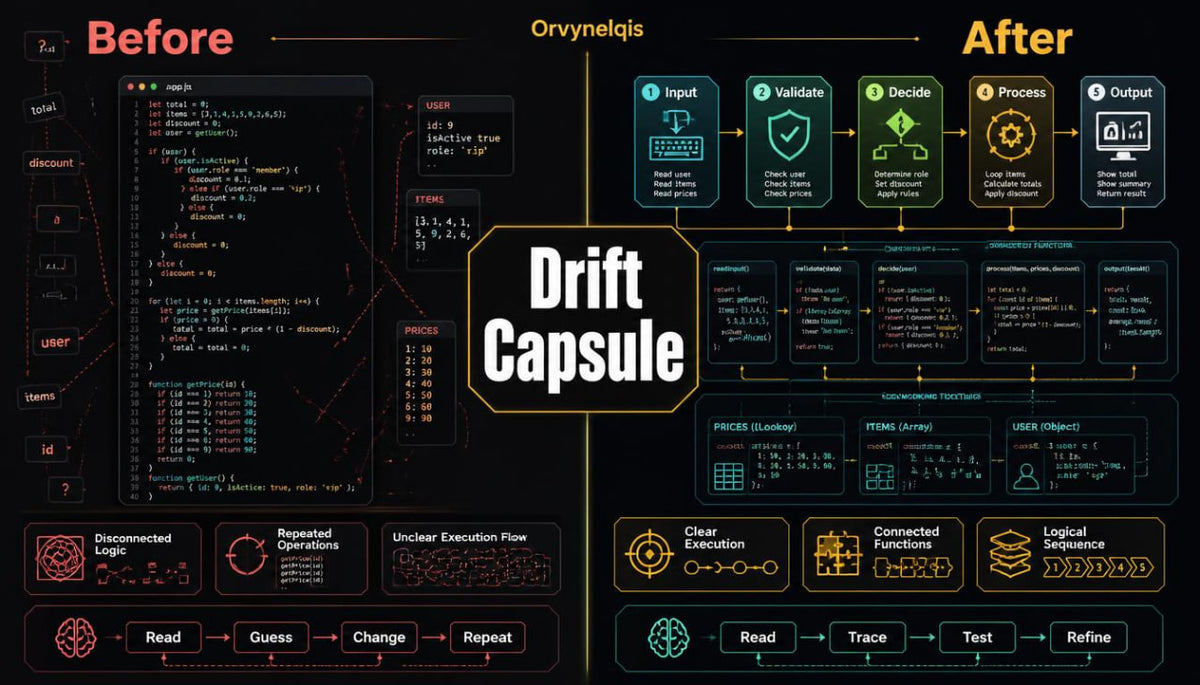
Understanding individual JavaScript statements is an important starting point, but combining those statements into meaningful operations introduces a different set of challenges. Learners may recognize variables, conditions, and functions separately while finding it difficult to determine how these elements should interact within a longer piece of code. As programming exercises become more detailed, questions arise about organizing information, controlling execution, and choosing appropriate structures for different tasks. Reading examples without examining the reasoning behind them can leave important connections between concepts unexplored. Developing a clearer understanding of these relationships requires structured practice that moves from isolated instructions toward connected programming activities.
2. Solution
Drift Capsule approaches JavaScript through a series of connected learning activities that demonstrate how foundational language features work together. The course introduces increasingly detailed examples while explaining the purpose of each operation and the reasoning behind its structure. Learners examine how values move between functions, how conditions influence execution, and how collections organize related information. Guided exercises invite readers to modify existing code, compare different approaches, and construct small solutions using familiar concepts. The materials establish a practical learning sequence centered on code organization, logical reasoning, and the development of reusable programming structures.
3. What's Inside
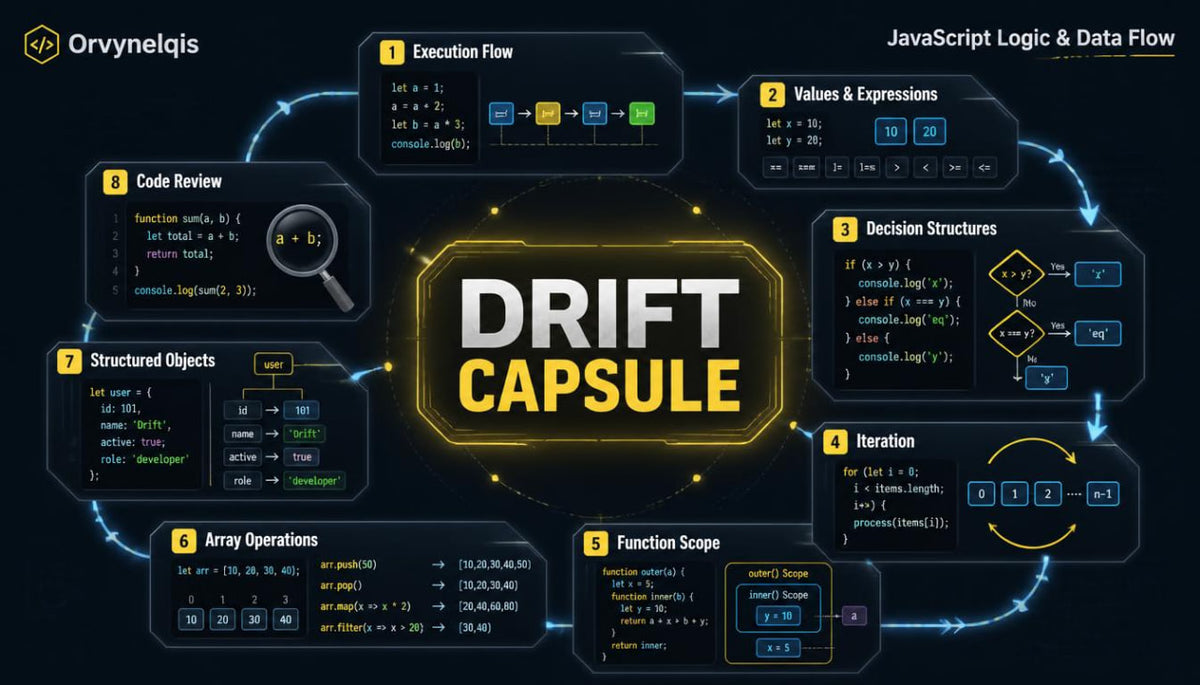
Module 1 — Reading the Flow of a Program
The opening module examines how JavaScript evaluates instructions and how the order of execution influences the behavior of a program.
Learners explore the difference between expressions and statements, examine blocks of code, and investigate how individual operations contribute to a larger sequence.
Special attention is given to understanding what happens when JavaScript encounters an expression, performs a comparison, or calls a function.
Examples demonstrate how changing the order of instructions can influence the final result.
The practical activity involves tracing a short program, documenting the value of each variable at different stages, and explaining the sequence of operations in written form.
Module 2 — Working With Values and Expressions
This module explores the relationship between data types, operators, and the values produced by expressions.
Learners revisit strings, numbers, and Boolean values while examining how JavaScript handles operations involving different types of information.
Topics include assignment operators, comparison expressions, logical operators, and introductory type conversion.
The material explains the difference between strict and loose comparisons, highlighting how the underlying values and types influence evaluation.
Practical exercises involve building expressions, examining unexpected results, and rewriting comparisons to make their intended behavior clearer.
Module 3 — Building Logical Decision Structures
Conditional logic provides a way to describe different actions for different circumstances.
This module expands upon introductory conditional statements by exploring nested conditions, combined expressions, and the organization of multiple decision paths.
Learners examine how complex conditions can be divided into smaller expressions and how the arrangement of branches affects readability.
Examples include categorizing numeric values, checking text input, and applying several conditions to the same collection of information.
A guided activity involves creating a simple classification system that evaluates provided data and returns an appropriate category.
The accompanying review encourages readers to examine alternative structures and consider whether each condition is necessary.
Module 4 — Repetition, Iteration, and Control
Loops become particularly useful when working with sequences of information.
This section examines for, while, and for...of structures, focusing on their differences and appropriate applications.
Learners investigate loop initialization, continuation conditions, iteration steps, and the relationship between repetition and changing values.
The module introduces break and continue, explaining how these statements influence the flow of execution.
Examples demonstrate counting operations, examining collections, accumulating totals, and finding values that meet specified conditions.
The practical exercise involves processing a collection of numeric entries and producing a short summary based on clearly defined rules.
Module 5 — Functions That Organize Ideas
Functions are examined as individual units of behavior that can receive information, perform operations, and return results.
Learners explore function declarations, function expressions, and arrow function syntax.
The materials explain parameters, arguments, return statements, and the difference between producing a value and displaying information.
Examples demonstrate how a longer sequence of instructions can be divided into smaller functions, each responsible for a particular operation.
The module also introduces local scope and explains how variable placement influences where a value can be referenced.
A guided activity involves creating several connected functions that process information and return a structured summary.
Module 6 — Arrays as Organized Collections
This module introduces a more detailed examination of arrays and their role in JavaScript programming.
Learners explore indexing, array length, adding and removing elements, and iterating through stored values.
The course introduces methods such as push(), pop(), includes(), and slice(), demonstrating their behavior through practical examples.
Readers examine the difference between changing an existing collection and creating a separate collection of values.
Activities involve organizing a small set of records, identifying matching entries, and calculating summaries from numeric arrays.
The module concludes with an exercise combining loops, functions, and arrays within one programming task.
Module 7 — Objects and Structured Information
Objects provide a way to represent information through named properties.
This module examines object creation, property retrieval, property modification, and the relationship between objects and arrays.
Learners explore dot notation and bracket notation while examining how individual objects can describe related pieces of information.
Examples include structured learning records, item descriptions, and collections of objects containing several properties.
A guided exercise involves building a small catalog of records and writing functions that retrieve, compare, and organize the stored information.
The material also introduces the distinction between primitive values and object references.
Module 8 — Reviewing Behavior and Finding Mistakes
The final module introduces a practical approach to examining code behavior and identifying common mistakes.
Learners study syntax errors, logical mistakes, unexpected values, and situations where an operation produces a result different from the one intended.
The course demonstrates how to examine variable values, follow the sequence of operations, and isolate individual sections of code for closer inspection.
Examples include incorrect comparisons, missing return statements, misplaced conditions, and loop boundaries.
The concluding activity brings together the previous modules in a small record-processing exercise that uses arrays, objects, functions, and conditional logic.
Learners are invited to review the code, identify its individual responsibilities, and make several documented modifications.
4. Who Is This For?
Drift Capsule is intended for learners who have encountered introductory JavaScript concepts and would like to examine how those concepts work together in longer examples.
The course is suitable for individuals familiar with basic variables, data types, conditional statements, and introductory functions.
It may also be useful for readers returning to JavaScript after an introductory study period who want structured opportunities to revisit foundational topics through connected activities.
Rather than introducing complex application architecture, the course concentrates on practical language behavior, code organization, and logical reasoning.
Learners who enjoy examining examples, experimenting with different values, and understanding why particular structures behave as they do will find relevant material throughout the course.
5. What You'll Learn
The course explores the following knowledge areas and practical skills:
-
Interpret the order in which JavaScript statements execute.
-
Identify the relationship between expressions, operations, and returned values.
-
Work with common data types and introductory type conversion.
-
Distinguish strict comparisons from loose comparisons.
-
Construct conditional statements involving several logical expressions.
-
Organize decision-making structures into readable branches.
-
Apply different loop structures to repetitive programming tasks.
-
Use iteration to examine and summarize collections.
-
Write functions with parameters and return values.
-
Recognize the relationship between local variables and function scope.
-
Apply introductory array methods to organize collections.
-
Create and modify objects containing named properties.
-
Combine arrays and objects to represent structured records.
-
Divide longer programming tasks into smaller functions.
-
Trace variable changes to investigate unexpected behavior.
-
Identify common syntax and logical errors.
-
Review code organization and consider alternative approaches.
-
Combine foundational JavaScript concepts within a connected practical exercise.
6. 30-Day Refund Terms
Drift Capsule is a paid educational course containing structured JavaScript learning materials and practical exercises.
A refund may be requested within 30 days following purchase, in accordance with the conditions stated in the Orvynelqis Refund Policy.
Learners are encouraged to review the course description, included topics, and refund conditions before completing a purchase.
Refund requests can be directed to the contact details provided on the website, where they will be reviewed according to the published policy.
The course is intended for independent educational study, and individual learning experiences depend on the reader's previous knowledge, engagement with the materials, and time spent practicing.
How are Orvynelqis courses organized?
How are Orvynelqis courses organized?
Our JavaScript courses follow a structured learning approach, with topics arranged into sections that connect related concepts. Each course focuses on specific areas of JavaScript, combining explanations, practical examples, and exercises. The depth of the material varies depending on the selected course.
Do I need previous programming knowledge?
Do I need previous programming knowledge?
Required background knowledge depends on the course you choose. Introductory materials explain fundamental programming concepts, while later courses examine more detailed techniques and development practices. Review each course description to understand its topics and recommended starting knowledge.
What will I find in the learning materials?
What will I find in the learning materials?
Course materials cover JavaScript concepts through written explanations, code examples, practical tasks, and topic reviews. The exact subjects and activities depend on the course. Each description outlines its learning focus so you can choose materials that match your interests.
- 📥 Digital file available after purchase
- 📚 Long-term availability
- 🔒 Secure checkout
- 📅 Content updated in 2026
Self-paced learning overview
Share