Orvynelqis
Cipher Framework
Cipher Framework
Couldn't load pickup availability
1. Problem Statement
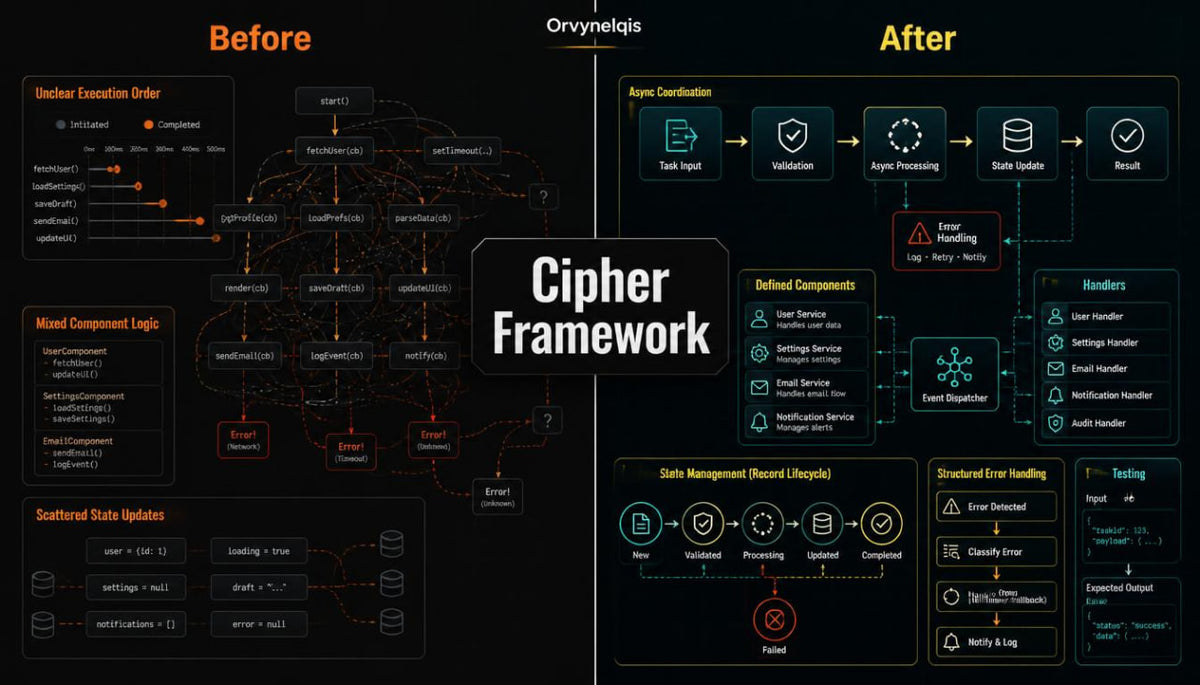
As JavaScript programs involve increasingly detailed operations, understanding how different components interact becomes an important part of writing organized and reliable code. Learners may already understand functions, objects, modules, and collection processing but encounter difficulties when operations occur at different times or depend on information produced elsewhere. Unexpected execution order, changing application state, and unclear communication between components can make programming behavior difficult to examine. As additional operations become connected, identifying the source of an error or understanding how information moves through the system may require a more deliberate approach. Learning to organize asynchronous behavior, manage dependencies, and define clear component boundaries provides a foundation for working with detailed JavaScript programming structures.
2. Solution
Cipher Framework introduces a structured approach to coordinating JavaScript operations through carefully arranged modules and connected programming exercises. The course examines how asynchronous execution, event-driven behavior, and modular design influence the organization of larger programs. Learners explore techniques for defining component responsibilities, managing changing information, handling unexpected conditions, and examining execution order. Guided activities demonstrate how individual programming structures communicate while keeping their responsibilities clearly defined. The materials conclude with an applied framework-building project that combines asynchronous operations, validation, state management, and structured testing.
3. What's Inside
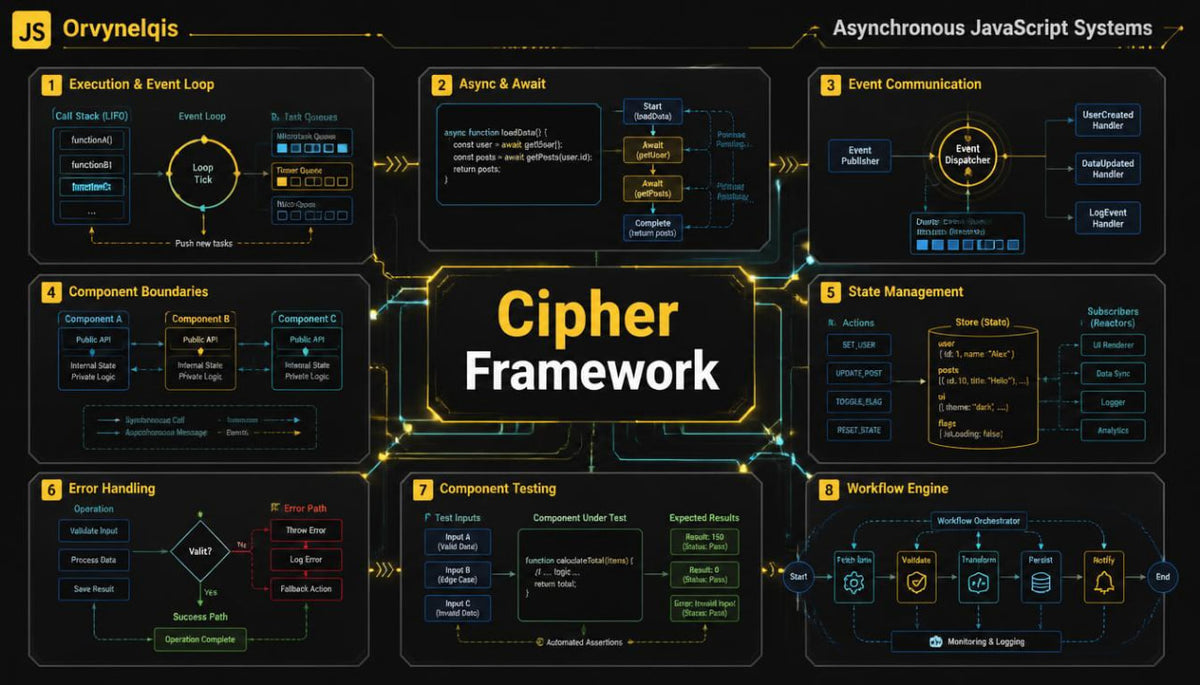
Module 1 — Understanding JavaScript Execution
The opening module examines how JavaScript processes instructions and coordinates operations within a running program.
Learners explore the call stack, execution contexts, and the relationship between function calls and returned values.
The materials introduce the event loop and explain how scheduled operations interact with synchronous instructions.
Examples demonstrate how the order in which statements appear can differ from the order in which certain scheduled operations complete.
A practical activity involves predicting the output of short programs containing ordinary function calls, scheduled callbacks, and asynchronous functions.
Readers examine execution sequences and document the relationship between individual operations.
Module 2 — Working With Asynchronous Operations
Many JavaScript workflows involve tasks whose results are not available immediately.
This module introduces asynchronous programming through async and await, examining how functions can coordinate operations that complete at different times.
Learners explore how asynchronous functions return their results and how subsequent instructions depend on those results.
Examples demonstrate simulated information retrieval, delayed calculations, and sequences of dependent operations.
The course also examines the difference between sequential processing and initiating independent operations together.
A guided exercise involves constructing an asynchronous record-processing sequence that retrieves information, validates its structure, and prepares a summary.
Module 3 — Coordinating Events and Callbacks
Event-driven programming organizes behavior around operations that occur in response to defined events.
This module examines callback functions, event handlers, and the relationship between an event source and its associated operations.
Learners explore how events can communicate changes without requiring every component to call another component directly.
The materials introduce a small event dispatcher constructed with ordinary JavaScript functions and collections.
Examples demonstrate registering handlers, communicating data through events, and removing handlers that are no longer needed.
A practical activity involves building a notification sequence for a fictional record catalog, with events representing record creation, modification, and removal.
Module 4 — Designing Component Boundaries
As programming systems develop, dividing operations into clearly defined components becomes increasingly important.
This module explores the relationship between modules, component responsibilities, and communication boundaries.
Learners examine how one component can request information from another without relying on unrelated internal details.
The course introduces interface-like agreements through function signatures, expected data structures, and documented return values.
Examples demonstrate separating data preparation, validation, processing, and result formatting.
A guided exercise involves restructuring a collection of closely connected functions into components that communicate through clearly defined operations.
Readers also examine how unnecessary dependencies can complicate later modifications.
Module 5 — Managing State Across Operations
Application state represents information that changes as different operations are performed.
This module examines how JavaScript programs can organize state and coordinate updates across connected functions.
Learners revisit object references, closures, and immutable update techniques.
The materials introduce a small state container that maintains a collection of records and provides defined operations for examining and modifying them.
Examples demonstrate adding records, updating selected properties, and producing revised collections without directly changing unrelated information.
A practical activity involves creating a state manager that records updates and communicates selected changes to other components.
Module 6 — Validation and Error Boundaries
Connected operations frequently depend on information received from different functions or data sources.
This module examines how validation can be positioned at defined boundaries within a JavaScript workflow.
Learners explore data validation, error classification, and the distinction between expected validation results and execution exceptions.
The course revisits try, catch, and throw, introducing more detailed examples involving asynchronous functions.
Readers examine how errors can move through connected operations and where they should be handled.
A guided exercise involves building a processing sequence that identifies invalid records, describes errors, and continues handling unrelated valid information according to defined rules.
Module 7 — Testing Connected Behavior
Examining individual functions is only one part of understanding a connected JavaScript system.
This module introduces testing techniques for multiple components operating together.
Learners explore input preparation, expected behavior, controlled test data, and comparisons between actual and expected results.
Examples include asynchronous functions, state changes, event notifications, and validation procedures.
The materials demonstrate how simulated dependencies can help examine individual components without requiring every related operation to run.
A practical activity involves preparing test scenarios for a state-management component, including empty collections, invalid inputs, repeated updates, and asynchronous errors.
Module 8 — Improving Structure Through Refactoring
Programming structures often need revision as their responsibilities become clearer.
This module examines how existing JavaScript code can be reorganized while retaining its intended observable behavior.
Learners identify repeated logic, oversized functions, unclear dependencies, and components containing unrelated responsibilities.
The materials demonstrate how code can be divided into smaller operations and reorganized around meaningful boundaries.
Examples compare several structural arrangements for the same record-processing task.
A guided activity involves reviewing an existing module, preparing tests for its current behavior, and reorganizing its functions.
The closing discussion considers how naming, documentation, and consistent data structures contribute to long-term code maintenance.
Module 9 — Applied Project: The Cipher Workflow Engine
The concluding project combines the course topics through the construction of a modular JavaScript workflow engine.
Learners begin by designing a collection of fictional processing tasks, each containing an identifier, input data, an operation type, and a current state.
The project introduces separate components responsible for task creation, validation, execution, and result storage.
Readers construct asynchronous functions that process tasks and report their completion through an event-based communication structure.
A state-management component records task changes and maintains the current collection of results.
Additional exercises involve identifying invalid tasks, handling execution errors, and documenting the sequence of operations.
The final stage introduces testing scenarios that examine component communication, state updates, and asynchronous behavior.
Learners complete the project by preparing a structural diagram and explaining how information moves through the workflow engine.
4. Who Is This For?
Cipher Framework is intended for learners who already understand JavaScript fundamentals and have experience working with functions, objects, modules, and structured data operations.
The course is suitable for individuals interested in asynchronous programming, component organization, event-driven behavior, and maintaining changing application information.
It may also be relevant for learners who have completed smaller modular projects and want to examine how multiple programming components coordinate their operations.
Readers should be familiar with JavaScript syntax, collection methods, functions, object references, and introductory error handling.
The course concentrates on connected programming structures and their behavior rather than introductory language concepts.
5. What You'll Learn
Cipher Framework covers the following practical skills and programming concepts:
-
Describe JavaScript execution contexts and the call stack.
-
Explain the relationship between synchronous and asynchronous operations.
-
Examine the behavior of the event loop.
-
Write asynchronous functions using
asyncandawait. -
Coordinate sequential and independent operations.
-
Construct callback-based programming structures.
-
Create an introductory event dispatcher.
-
Organize event handlers and communicate event information.
-
Define responsibilities for individual programming components.
-
Design clear communication boundaries between modules.
-
Manage application state through reusable functions.
-
Apply immutable update techniques to structured records.
-
Validate information at defined processing boundaries.
-
Handle errors in asynchronous programming workflows.
-
Prepare test scenarios for connected components.
-
Use simulated dependencies during component testing.
-
Identify unnecessary dependencies and repeated logic.
-
Refactor connected operations while retaining their intended behavior.
-
Construct a modular workflow engine using JavaScript.
-
Document component relationships and execution sequences.
6. 30-Day Refund Information
Cipher Framework is a paid educational course containing structured JavaScript learning materials, technical explanations, programming examples, and applied exercises.
Learners may request a refund within 30 days following purchase, subject to the conditions outlined in the published Orvynelqis Refund Policy.
Refund requests can be submitted using the contact information provided on the Orvynelqis website.
Each request will be reviewed according to the published refund procedures and applicable consumer protection requirements.
Before purchasing, learners are encouraged to review the course contents, recommended background knowledge, and refund conditions.
The materials are intended for independent educational study, allowing readers to revisit technical explanations, examine programming examples, and complete practical tasks according to their individual study schedules.
Individual learning progress depends on previous programming knowledge, engagement with the exercises, and time devoted to reviewing the material.
How are Orvynelqis courses organized?
How are Orvynelqis courses organized?
Our JavaScript courses follow a structured learning approach, with topics arranged into sections that connect related concepts. Each course focuses on specific areas of JavaScript, combining explanations, practical examples, and exercises. The depth of the material varies depending on the selected course.
Do I need previous programming knowledge?
Do I need previous programming knowledge?
Required background knowledge depends on the course you choose. Introductory materials explain fundamental programming concepts, while later courses examine more detailed techniques and development practices. Review each course description to understand its topics and recommended starting knowledge.
What will I find in the learning materials?
What will I find in the learning materials?
Course materials cover JavaScript concepts through written explanations, code examples, practical tasks, and topic reviews. The exact subjects and activities depend on the course. Each description outlines its learning focus so you can choose materials that match your interests.
- 📥 Digital file available after purchase
- 📚 Long-term availability
- 🔒 Secure checkout
- 📅 Content updated in 2026
Self-paced learning overview
Share