Orvynelqis
Arc Series
Arc Series
Couldn't load pickup availability
1. Problem Statement
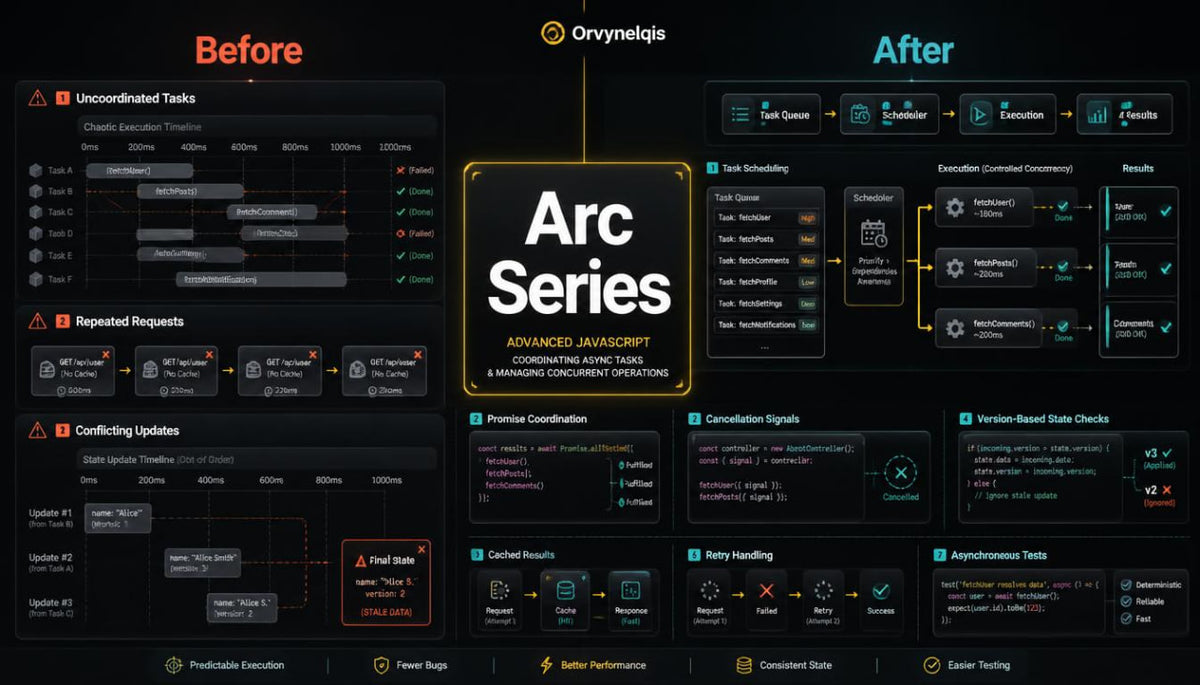
As JavaScript applications begin coordinating multiple asynchronous operations, understanding how information moves between connected components becomes increasingly demanding. Learners may understand individual asynchronous functions but encounter difficulties when several operations must run concurrently, respond to changing conditions, or depend on shared information. Unexpected completion order, repeated requests, inconsistent state updates, and incomplete error handling can make programming behavior difficult to interpret. Without a structured approach to coordinating these activities, adding new functionality may introduce unnecessary dependencies and unpredictable interactions between components. Examining asynchronous coordination, task management, and communication patterns provides a foundation for understanding how detailed JavaScript systems behave under different execution conditions.
2. Solution
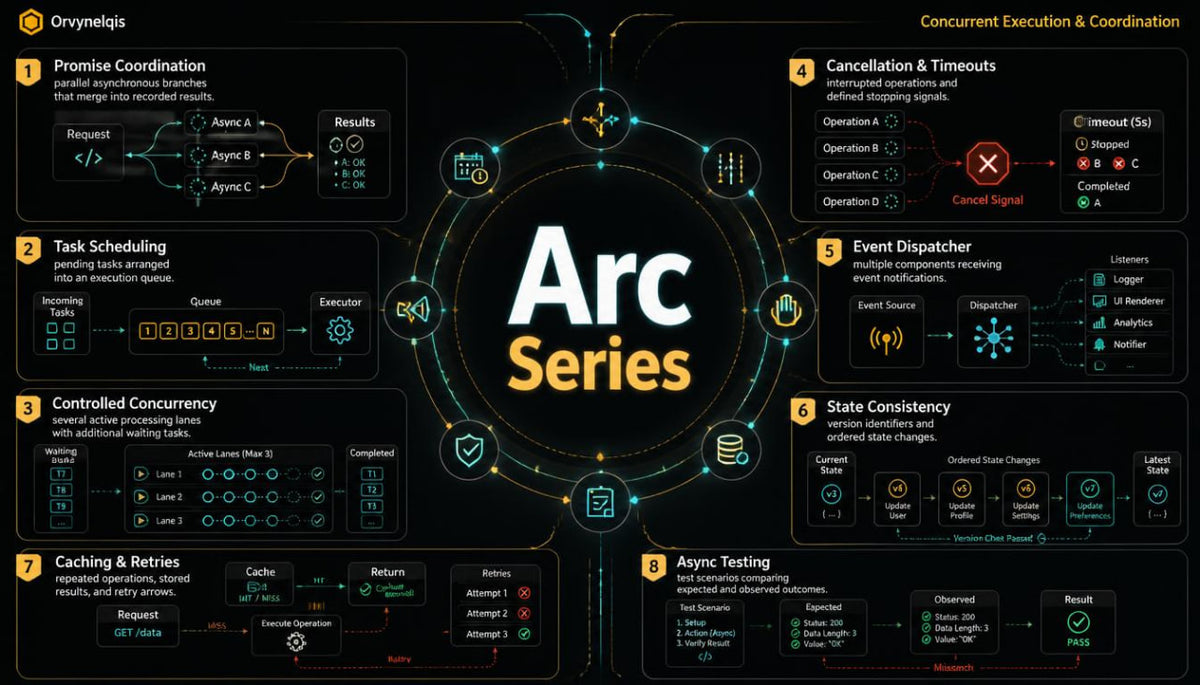
Arc Series presents a structured examination of advanced JavaScript coordination through connected lessons, technical examples, and applied programming exercises. The course explores how asynchronous operations can be grouped, scheduled, monitored, and handled through clearly defined programming structures. Learners investigate techniques for controlling concurrent activities, organizing shared information, and communicating changes between components. Guided exercises demonstrate how different execution arrangements influence application behavior and how individual operations can be examined through controlled test scenarios. The materials bring these concepts together in a practical coordination project involving task queues, event notifications, state updates, and detailed processing reports.
3. What's Inside
Module 1 — The Anatomy of Asynchronous Execution
The opening module examines how JavaScript coordinates synchronous instructions with operations that complete at different times.
Learners revisit the call stack and event loop before exploring the relationship between tasks, microtasks, and scheduled callbacks.
The materials examine how promise callbacks interact with ordinary instructions and why execution order matters when several operations are connected.
Examples demonstrate how Promise.resolve(), scheduled callbacks, and asynchronous functions influence the order of observable results.
A practical exercise involves predicting execution sequences, comparing them with actual behavior, and documenting the reason behind each outcome.
Module 2 — Coordinating Promises
Promises provide a structured way to represent the eventual completion or rejection of an asynchronous operation.
This module develops an understanding of promise states, chaining, fulfillment values, and rejection handling.
Learners examine Promise.all(), Promise.allSettled(), Promise.race(), and Promise.any() through practical examples.
The materials compare how each method behaves when operations complete, reject, or return different results.
A guided exercise involves coordinating several simulated information-retrieval tasks and preparing a summary of their completion states.
Readers also examine how error handling differs between individual promises and grouped operations.
Module 3 — Building Controlled Task Queues
Some programming workflows require tasks to be processed according to defined rules rather than initiated together without coordination.
This module introduces task queues and explores how pending operations can be organized into manageable sequences.
Learners examine queue ordering, active task counts, completion records, and controlled concurrency.
The course demonstrates how a small JavaScript scheduler can initiate a defined number of operations while retaining additional tasks for later processing.
Examples involve fictional document-processing requests with different durations and outcomes.
A practical activity involves constructing a task queue that records pending, active, completed, and rejected operations.
Module 4 — Cancellation, Timeouts, and Task Lifecycles
Asynchronous operations may become unnecessary when a user changes an action or when a processing condition changes.
This section introduces cancellation concepts and examines how JavaScript can communicate that an operation should stop.
Learners explore AbortController and AbortSignal, including how cancellation signals can be passed between connected functions.
The materials also examine timeout patterns and the difference between ending a waiting operation and stopping the underlying activity.
Examples demonstrate task cancellation, expired operations, and cleanup procedures.
A guided exercise involves adding cancellation and timeout handling to the task queue developed in the previous module.
Module 5 — Event-Based Component Communication
Connected components often need to communicate changes without relying on direct calls between every participating function.
This module expands event-driven programming through practical communication patterns.
Learners create an event dispatcher that supports registration, notification, and removal of handlers.
The course explores event payloads, listener ordering, and the behavior of handlers when an event occurs.
Examples demonstrate task-start notifications, completion events, and error reports.
Readers examine how event-based communication differs from direct function calls.
A practical activity involves connecting the task queue to an event dispatcher that communicates changes to a separate reporting component.
Module 6 — State Coordination and Data Consistency
When several asynchronous operations update related information, understanding the order of those changes becomes important.
This module examines shared state, update sequencing, and the relationship between asynchronous completion and stored values.
Learners explore situations where an earlier operation completes after a later one and changes information that has already been updated.
The materials introduce operation identifiers, version checks, and controlled update functions.
Examples demonstrate how related tasks can produce conflicting results when their completion order differs from their initiation order.
A guided activity involves building a state manager that compares operation identifiers before applying selected updates.
Module 7 — Caching and Repeated Operations
Repeated calculations or information requests may involve identical inputs and results.
This module introduces caching as a technique for storing selected results for later use.
Learners explore cache keys, stored values, expiration rules, and the distinction between an existing entry and a missing entry.
The course demonstrates how Map can support a small in-memory cache.
Examples include repeated calculations, record retrieval, and processing operations that receive identical parameters.
Readers examine how cached information can become outdated and how invalidation rules influence the behavior of connected components.
A practical activity involves integrating a configurable cache into a fictional information-processing workflow.
Module 8 — Error Recovery and Operational Reporting
Asynchronous systems may encounter invalid inputs, rejected operations, unexpected values, or interruptions.
This module examines how different failure conditions can be classified and represented.
Learners explore error propagation, retry logic, attempt counters, and structured processing results.
The materials discuss why repeated operations should be evaluated carefully when they modify existing information.
Examples demonstrate handling temporary processing failures, recording rejected tasks, and distinguishing cancellation from other error conditions.
The course introduces structured diagnostic records containing task identifiers, timestamps, operation names, and completion states.
A guided exercise involves preparing a processing report that describes individual task outcomes and the circumstances associated with unsuccessful operations.
Module 9 — Testing Asynchronous Behavior
Asynchronous programming requires examining both returned information and the order in which operations occur.
This module introduces test scenarios involving delayed results, rejected promises, cancellation, and shared state changes.
Learners explore controlled asynchronous functions that return predetermined values under specified conditions.
The materials explain how test data can represent different execution sequences without relying on unpredictable timing.
Examples examine empty task queues, repeated submissions, simultaneous operations, and rejected processing tasks.
Readers also review how to compare expected task states with actual processing records.
A practical activity involves preparing a collection of test scenarios for the course task scheduler.
Module 10 — Applied Project: The Arc Coordination Studio
The concluding project combines the course concepts through a modular JavaScript task-coordination system.
Learners begin by defining a task structure containing an identifier, operation type, input data, processing state, and result information.
The project introduces a scheduler responsible for coordinating pending operations according to defined concurrency rules.
Readers connect promise-based execution to the scheduler and add event notifications for task creation, initiation, completion, and rejection.
Additional components manage state updates, cancellation requests, and selected cached results.
The next stage introduces error classification, retry rules, and structured diagnostic records.
Learners then prepare test scenarios involving delayed operations, rejected promises, repeated inputs, and task cancellation.
The final review examines the connections between scheduling, event communication, state coordination, and reporting functions.
Participants document the role of each component and explain how information moves through the complete programming workflow.
4. Who Is This For?
Arc Series is intended for learners who already understand JavaScript functions, modules, objects, promises, and introductory asynchronous programming.
The course is suitable for individuals who have worked with connected programming components and want to examine more detailed execution and coordination techniques.
It is particularly relevant for learners interested in task scheduling, event-driven communication, state management, and structured handling of asynchronous results.
Readers should be familiar with async, await, function callbacks, collection methods, and introductory error handling before beginning the material.
The course focuses on technical coordination and practical programming architecture rather than introductory language syntax.
5. What You'll Learn
Arc Series covers the following programming concepts and practical skills:
-
Examine the relationship between the call stack, event loop, and microtasks.
-
Interpret asynchronous execution sequences.
-
Coordinate grouped operations with JavaScript promise methods.
-
Compare sequential execution with concurrent processing.
-
Design task queues with defined execution rules.
-
Track pending, active, completed, and rejected operations.
-
Apply controlled concurrency to task-processing workflows.
-
Explore cancellation through
AbortControllerandAbortSignal. -
Construct timeout-handling procedures.
-
Create event dispatchers for component communication.
-
Manage event handlers and structured notification data.
-
Coordinate updates to shared application state.
-
Identify conflicting asynchronous updates.
-
Apply version checks to selected state modifications.
-
Create in-memory caches using
Map. -
Define cache expiration and invalidation behavior.
-
Design structured asynchronous error responses.
-
Examine retry logic and operation attempt records.
-
Prepare diagnostic information for task-processing workflows.
-
Write tests for delayed and rejected asynchronous operations.
-
Compare expected execution behavior with recorded results.
-
Build a modular task-coordination system.
-
Document component relationships and processing sequences.
6. 30-Day Refund Terms
Arc Series is a paid educational course containing structured JavaScript learning materials, technical explanations, programming examples, and applied exercises.
Learners may submit a refund request within 30 days following purchase, according to the conditions stated in the published Orvynelqis Refund Policy.
Refund requests can be submitted through the contact information provided on the Orvynelqis website.
Each request will be reviewed according to the published procedures and applicable consumer protection requirements.
Learners are encouraged to examine the course description, recommended background knowledge, included modules, and refund conditions before completing a purchase.
The materials are intended for independent educational study, allowing learners to revisit technical explanations and complete practical exercises according to their individual schedules.
Individual learning progress depends on previous knowledge, participation in exercises, and the time devoted to examining the materials.
How are Orvynelqis courses organized?
How are Orvynelqis courses organized?
Our JavaScript courses follow a structured learning approach, with topics arranged into sections that connect related concepts. Each course focuses on specific areas of JavaScript, combining explanations, practical examples, and exercises. The depth of the material varies depending on the selected course.
Do I need previous programming knowledge?
Do I need previous programming knowledge?
Required background knowledge depends on the course you choose. Introductory materials explain fundamental programming concepts, while later courses examine more detailed techniques and development practices. Review each course description to understand its topics and recommended starting knowledge.
What will I find in the learning materials?
What will I find in the learning materials?
Course materials cover JavaScript concepts through written explanations, code examples, practical tasks, and topic reviews. The exact subjects and activities depend on the course. Each description outlines its learning focus so you can choose materials that match your interests.
- 📥 Digital file available after purchase
- 📚 Long-term availability
- 🔒 Secure checkout
- 📅 Content updated in 2026
Self-paced learning overview
Share